
Trace Piute County Former Owners
Two routes lead through Piute County's ownership trail. The current one runs through the Recorder's public search application, though the county does not publish the index's start year or its list of searchable fields. History opens other doors. State Archives catalogs a single deed microfilm reel for the county, and FamilySearch lists Piute probate and court materials with stated coverage spans. Unknown date ranges stay visible rather than guessed.
| Source | Years It Covers | Where Held | What It Shows |
|---|---|---|---|
| Piute recorder index | Online cutoff not published | Piute County Recorder-Treasurer | Current recorded filings; confirm date and fields |
| Series 84048 deed reel | One reel; date span not stated in the catalog summary | Utah State Archives | Historic Piute deed copies and named deed types |
| Piute court catalog | Books A, 1869-1874; B, 1872-1908; roads and bridges, 1872-1910 | FamilySearch catalog | Historic court and administrative records, not a title index |
| Piute probate collection | 1888-1932 | FamilySearch / Utah State Archives collection | Estate files that may explain a transfer |
Start with the Recorder. Ask whether its online index covers the period you need before relying on it. Older deeds have a fallback. The State Archives microfilm reel holds the county's earliest recorded land entries. Estate breaks call for the probate collection, paired with the deed that followed the transfer. Plats link lot and block wording to actual ground. Piute County publishes no year range for recorded plats or old tax rolls, so request those with a parcel clue instead of assuming a span.
Walk Back the Piute County Deed Chain
Each deed hands you the next name. Search the grantee as a grantor next. Utah's land-record guide keeps grantor and grantee indexes as separate party lists, and historical entries can carry instrument date, filing date, document type, and book/page. That detail matters. The county does not document which fields its web application accepts, so ask the Recorder before assuming name or date keys.
- Record the latest known deed's grantee, grantor, instrument date, and filing reference.
- Search the grantor as a grantee to find the prior acquisition deed.
- Repeat, checking the legal description at every transfer.
- When the online result stops, ask the Recorder or Archives about series 84048 and the relevant index.
- Grantor / grantee
- The transferring party and the receiving party named in an instrument.
- Chain of title
- The ordered sequence of recorded transfers tied to the land.
- Legal description
- A parcel's recorded land description, often more useful than an old street label.
Piute County's Unknown Web Cutoff
The Recorder's page links an online search. The county publishes no beginning year for it. No verified coverage cutoff exists, and no stated rule covers party searching or image access. Never write a guessed year into a chain table. Ask the Recorder when the web index stops and which book or index replaces it.
This gap shapes how former owners get researched. A failed web result can stem from spelling, a historic place name, a missing date field, or a period outside the online data. It does not prove the deed never existed. Keep the exact name and legal description. Ask staff about a counter lookup or an archival route for the missing link.
Build the inquiry one link at a time. Do not request every prior owner at once. Start with the newest deed or the assessor parcel number, record its grantor and grantee, then find the instrument by which that grantee acquired the interest. Repeat backward. Compare the legal description at every step. If a party changed name, acted as a fiduciary, or conveyed through a trust, preserve that wording and ask the Recorder which index entry follows it.
Keep instrument date and recording date in separate columns. Deeds get signed and entered on different days. A chain built from filing order alone may miss that distinction. Record the book/page or document number exactly as provided. Note which source returned it. Flag every gap for follow-up, since the chain may need to resume in a paper index or on microfilm once the web search ends before the property's earliest transfer.
Piute County's Single Deed Reel
Utah State Archives series 84048 is one microfilm reel. It catalogs Piute County Recorder deeds, with sheriff, administrator, quitclaim, guardian, probate, mayor, and trust deeds named in the description. The catalog posts no simple coverage span. Cite the series number in any request. Pair it with a party, date, or place clue; the series 84048 entry identifies the archival holding.
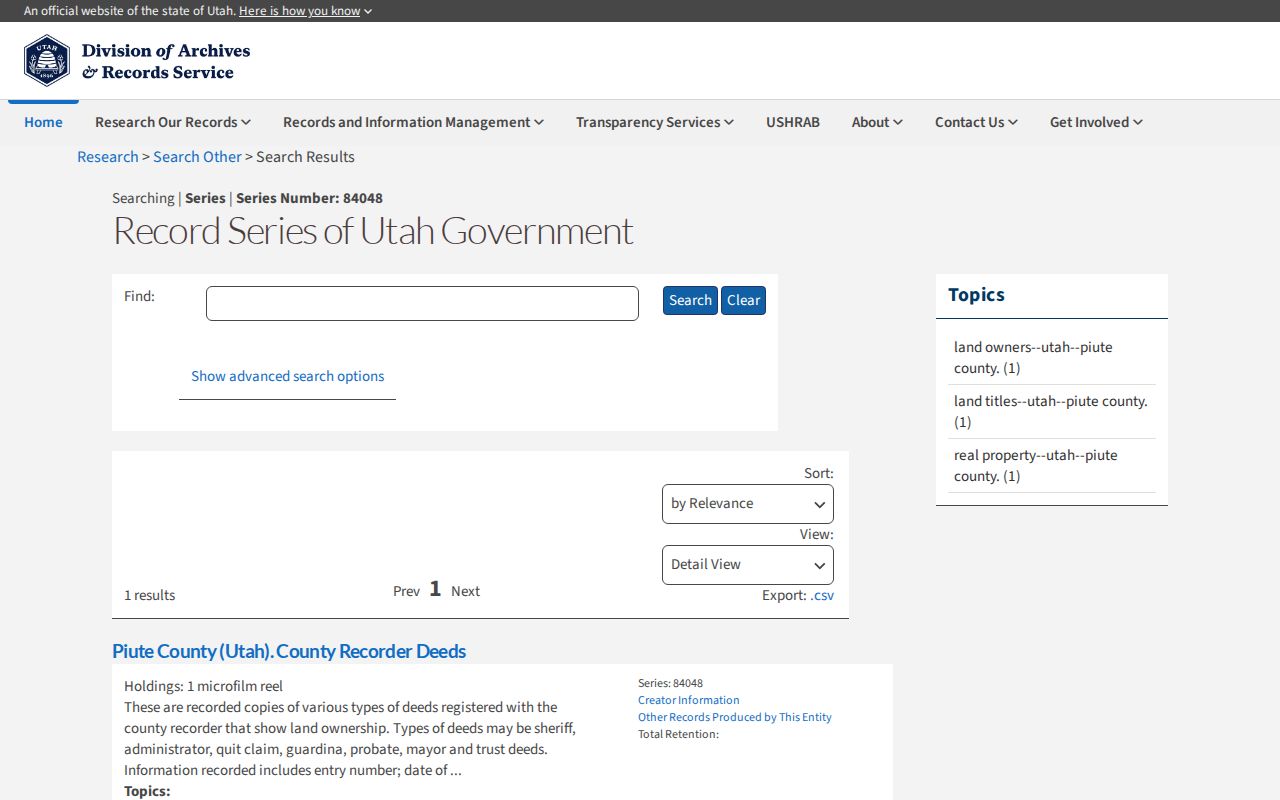
The catalog page names the reel and deed series. Confirm access and copy arrangements with the Archives. Use the series number in a request. Include the strongest clue available, whether a person's name, an approximate date, an instrument type, or a historic place. Name searching may not reach the reel online. Ask whether an index or entry book points to the frame you need. A reel can exist without every page digitized, and images may carry access restrictions the catalog does not state.
Piute County Probate Chain Breaks
Probate can change a chain of title. No sale between two people ever happens. Instead, a personal representative, administrator, guardian, or trust steps in as grantee while an estate is settled. FamilySearch's Utah State Archives collection holds Piute probate files from 1888 through 1932, and the record descriptions can name heirs, residences, witnesses, property text, and farm values.
Treat probate as an explanation, not proof. A death certificate or newspaper notice records an event, not a transfer. It never conveys title. Verify the conveyance in the Recorder's deed records. Certified-copy fees and current custody for present-day files are not published here, so check with Utah Courts or the relevant county custodian first.
Both the FamilySearch state archive collection and its Piute County court-record catalog sit on FamilySearch, and the catalog lists court books A and B plus roads-and-bridges records. Both are free.
The catalog screenshot shows a historical route; access to individual images can vary.
Piute County's Old Place Names
Old deeds describe land by places that no longer work as address keys. Bullion City appears in Piute's 1869 organization history. County offices today sit in Junction. Kimberly, Bullion Canyon, Webster, and Alunite turn up in mining, farm, plat, newspaper, and probate clues. Keep the original spelling when tracing a former owner.
Kimberly's mine employed about 300 workers around the turn of the century and closed in 1907, while Marysvale grew into a railroad and mining center after the Denver and Rio Grande arrived in 1900. Those facts explain a property description. They prove no ownership link. Confirm the parcel through a plat, deed, or archive index.
Piute County's Courthouse Move
Piute County's adobe courthouse opened in Junction in 1903. County offices worked there until March 1, 1997. The move went to the 550 N Main complex. The old building joined the National Register in 1971. A deed book, letter, or archival reference may still name the historic courthouse even though requests now go to the current county complex.
No courthouse fire, flood, or destruction event appears in any official report. Don't assume one. A gap in an online chain is not evidence. Ask the Recorder or Archives whether a book, index, or microfilm copy survives for the date in question.
A changed building address is not a break in the record. Old deeds may name the courthouse or an earlier clerk's office. Use the instrument date and series description to identify the record group, then contact the present custodian. The 1997 relocation is a location clue for reading old correspondence, not evidence that pre-move deeds are missing.
How Far Back Piute County Records Reach
The online cutoff is unknown. The county web page does not say when its deed index begins. The Archives' single-reel deed series remains the oldest land-record route. Utah's 1850 territorial ordinance and 1888 indexing law explain the broader recording system, but neither proves which Piute years sit in the present portal. A search limit is not a historical endpoint. Ask the custodian before treating it as one.
Lawful use. Former-owner research can support house history, title review, and property diligence. Do not use a chain of names to track, threaten, or harass a living person.