
Find Who Owns a Piute County Property
Ownership questions in Piute County run through three offices. The Assessor maintains the tax roll and its owner name. The Recorder-Treasurer keeps the filed deed that documents each transfer. UGRC's parcel data can help when a street address is vague. The Assessor publishes no searchable parcel card online. Begin with the office page or call 435-577-2988. Once you have a parcel number or a probable owner, take that clue to the Recorder-Treasurer at 435-577-2505. For a recent sale, the newest recorded deed is the strongest check.
- Give the Assessor the address or parcel clue and ask for its current owner-of-record information.
- Match the parcel to the UGRC PARCEL_ID if a map search is needed.
- Search the Recorder's index for the latest deed and compare grantor, grantee, date, and legal description.
- If an entity holds title, use the state business search as context, not as ownership proof.
Piute County Owner Record Sources
Piute County ownership clues come from three custodial sources. The assessor's roll answers assessment and classification questions. The recorder preserves the filings themselves. The state parcel layer adds mapped context. Because the county publishes no assessor-card sample online, the information below separates what each source actually establishes from fields you may need to request directly. The Piute County Assessor page gives the office route for a current owner-record question.
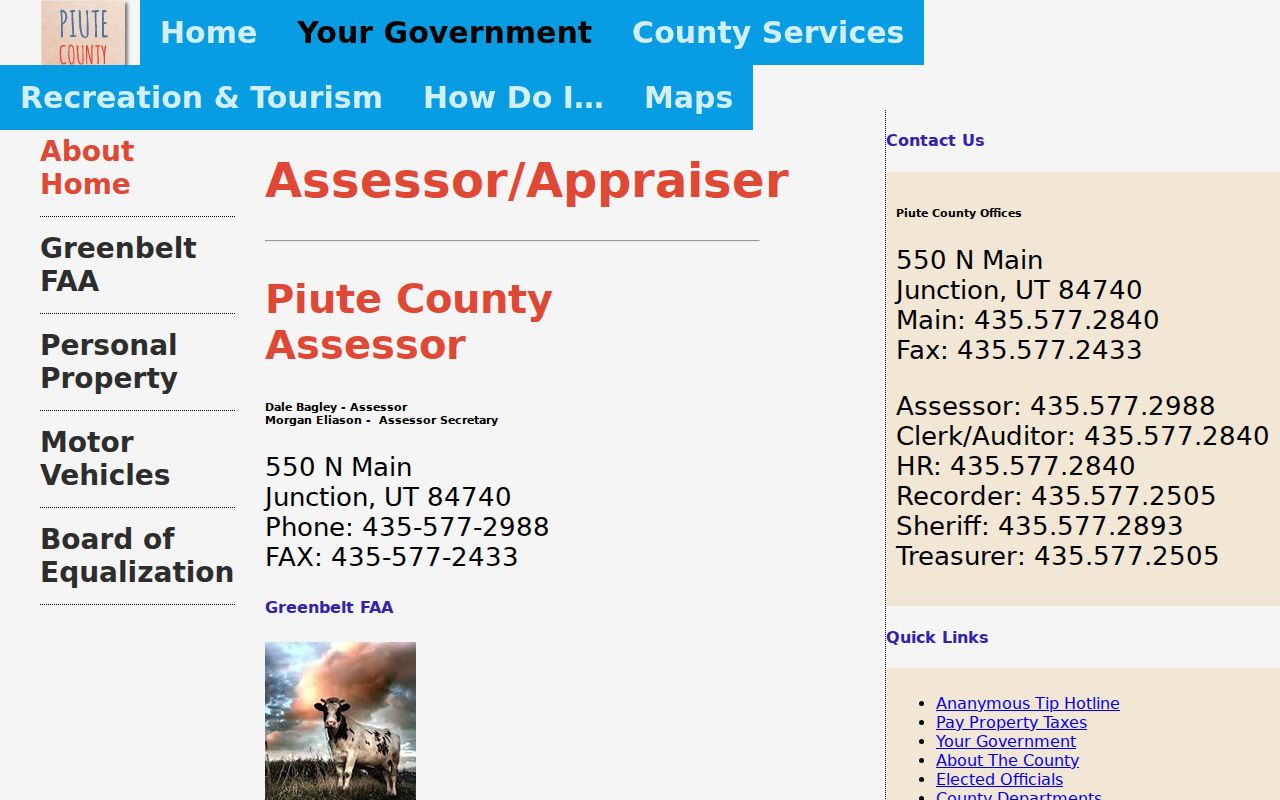
The Assessor page displays the office's contact information and valuation duties rather than a searchable parcel card.
| Source | Owner Info It Gives | Access |
|---|---|---|
| Assessor roll | Owner/value classification; exact field labels and card access not verified | Assessor page, phone, or counter |
| Recorder deed index | Filed grantor/grantee instrument and legal description | County search landing page; call for gaps |
| Utah business search | Entity context for an LLC or corporation named in a deed | State entity search; result fields not captured |
| UGRC parcel layer | PARCEL_ID and location attributes; ownership type is generalized | Public state parcel catalog |
An owner of record is simply the party named in a public land record. An occupant is not necessarily that owner. A name and a mailing address cannot tell you who lives at the property. The Recorder's grantee field, when a result includes one, identifies the transferee on that filing. It does not prove that no later deed exists. Keep the record date beside the name. An assessor entry answers a tax-roll question. A deed shows what one particular instrument transferred. When the names differ, the gap may reflect timing, a trust or estate, a spelling variation, or a mismatched parcel description. Ask each custodian which dated record it is describing instead of treating any single result as conclusive.
Piute County Parcel ID Bridge
When an address search stalls, UGRC's Piute parcel catalog offers the most concrete bridge. Its schema carries a unique PARCEL_ID along with PARCEL_ADD, PARCEL_CITY, and PARCEL_ZIP. The county documents no standard human-readable number pattern. Its parcel app's selection tools are not described publicly. Copy the identifier exactly as shown. Then ask the Assessor to confirm it matches the tax account. A parcel identifier cuts through confusion between similar street names or shared surnames. It does not name the legal owner on its own. The state data's ownership-type attribute is generalized context only. Confirm the person or entity in the county roll, then compare the recorded deed.
Confirm Piute County Ownership in a Deed
The Piute Recorder landing page covers deeds, liens and releases, mortgages, easements, subdivision plats, and other official filings. It links to an external search. The county does not publish the coverage start date or image fees. Confirm both with the office. Search the likely owner as grantee. Read the instrument itself. Check whether any later filing appears. If your question is historical, follow the grantor name back one step. Look closely at the document date, the recording date, the named parties, and the legal description. These fields can sit in different places on the instrument. For a just-completed sale, the newest recorded deed may postdate the assessor roll. The Piute County deed records route explains the recorded instrument trail in more depth. A deed confirms what that one filing says. It is not a complete title search, and unrecorded agreements can exist. When you read the party names, distinguish the person who signed for an entity from the entity named as grantee. Check whether a later document changes the interest. See if it corrects the description. It may also cover only part of the parcel. If the index lists several similar instruments, use the legal description and the recording reference. The Recorder can tell you which copy matches the property in question.
Piute County Trust and Estate Owners
Not every deed names a person. In Piute County, title often sits with a trust, corporation, limited liability company, administrator, or guardian. The county's historical deed series reflects this, with separate administrator, probate, guardian, and trust categories. FamilySearch's Piute probate coverage runs 1888 through 1932. Current court access and local probate filing details can be clarified through the Recorder's office.
An LLC or corporation sometimes appears as a deed party. Utah's business search can add context in that situation. It may list a registered agent or mailing address. That is not necessarily the person who owns the parcel or lives on it. Copy the entity's exact name and any capacity wording from the instrument, match it to the parcel, and ask the Recorder about the document before drawing a conclusion.
Estate transfers deserve a side-by-side look. Compare the probate material with the recorded conveyance. A probate index, obituary, or death record can explain the family event. None of them replaces the deed.
A company contact, trustee, or personal representative may be involved in the filing. A filing party is not always the owner. The public record traces the named legal party, not a person's residence or private role.
Piute County Mailing Address Limits
A tax mailing address and a situs address answer different questions. The situs is where the parcel sits. The mailing address is where tax notices go. It may be a post-office box, an agent, or an out-of-county address. Ask the Assessor how its address labels are defined before using a mailing address for any contact.
Utah's GRAMA law governs public access. Protected records and address-confidentiality programs can limit what is displayed or inferred. Safe at Home eligibility sits with the state program. The county offers no alert signup. Never try to identify a protected residence from a mismatch in the record, and direct records questions to the custodian.
Piute County Owner Search Fallback
When the online owner search comes up empty, go straight to the record keeper. The Assessor sits at 550 N Main in Junction, 435-577-2988, and the Recorder-Treasurer shares the same county complex at 435-577-2505. Ask which index key the office accepts and whether the owner field you want is public. The county's public-record search page points outward to other systems, so it will not show you its search fields in advance.
Older ownership has another route. State Archives series 84048 catalogs a single Piute deed microfilm reel, and the state land guide treats grantor and grantee indexes, entry books, abstracts, and map/plat indexes as separate tools. Ask the county or the Archives which tool fits your period and place clue. GRAMA opens the door to records. It does not promise that everything is online or unrestricted.
Frame your request so the office has a bounded task. Give the parcel identifier if you have it, a full legal description, one or both party names, an approximate year range, and the record type you need. Ask whether a name index, an instrument copy, or an abstract is the right starting point, and request a fee estimate for anything broad. A quick index lookup is one thing. A complete chain-of-title review is another, and pricing should reflect that difference.
Limits of a Piute County Owner Lookup
A Piute County owner lookup names parties. It does not confirm residence, occupancy, full title, or every private agreement. A mailing address can differ from the parcel's situs. Verify transfers with the Recorder, respect Utah's records classifications, and never expose or infer a protected address.
Lawful use. Use owner information for property research, boundary questions, and due diligence. Never use the records to stalk, threaten, or harm anyone, or to evade an address-confidentiality program.